Chart Settings - Data
The Chart Settings window consists of several thematic tabs of options for calculating and displaying horoscope charts. The Data tab contains settings for customizing the information displayed at the right of the Chart tableau. Some other general options are also set on this tab.
The Chart Settings - Data tab is opened by first:
- selecting "Settings" | "Chart Settings" from the main menu, or
- clicking the
 "Options" Toolbar button and selecting "Chart Settings..." from the menu, or
- right-clicking in the Chart tableau and selecting "Chart Settings..." from the popup menu, or
- double-clicking in an empty region of the Chart tableau.
Then by clicking the  "Data" button at the top of the window,
or typing the 'D' key.
"Data" button at the top of the window,
or typing the 'D' key.
The Data tab have several pages:
Table
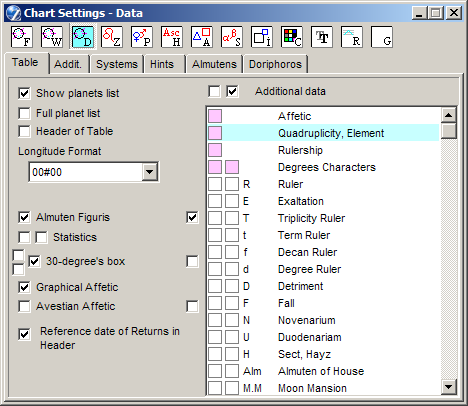
- Show Planets list (left checkbox) displays the core event data planets
of all charts; the background event data planets of dual charts;
and, for complex charts, the planets data for the pair of rings
selected in the Direction of Aspects window. I.e. one, two, or three columns of
data may be displayed,
- Full planet list (right checkbox) applies to complex charts only, and extends
the listing to display a column of planets' data for every ring of the complex chart.
- Header of Table checkbox - when checked, displays the headers of planet table.
- Format -
select from the drop-down list box the display format for
zodiacal positions (longitudes) of objects in the list.
Formats which contain a # symbol use astrological degree-of-sign representation.
The formats available are:
12 10
10
12°10'04"
12°10'03.93"
342.168°
342°10'
13°
12.1678
- "Almuten Figuris - displays the Almuten of the
chart on the tableau at bottom left.
To calculate the "Almuten Figuris" by Ibn Ezra, it need to take five points od horoscope (Sun, Moon, Ascendant, Parts of Fortune differ for day and night, Prenatal Syzygy, i.e. Moon's position in last new moon or full moon before birth). Then for every of these five points make calculation, similar as for house almuten: the ruler of point's sign gets 5, exaltant 4, triplisity by Dorotean 3, term ruler by Egiptian 2, face ruler 1. Then calculats a sum for every planets of septener.
Then a ruler of day gets 7, and a ruler of hour 6. Then every planet gets points for location in houses: in 1st house 12, in 2nd house 6, in 3rd house 3, in 4th house 9, in 5th house 7, in 6th house 1, in 7th house 10, in 8th house 4, in 9th house 5, in 10th house 11, in 11th house 8, in 12th house 2. The planet the maximum count of points is the "Almuten Figuris".To calculate the Almuten Figuris correctly, should be selected following options in the Chart Settings: triplisity by Dorotean, terms by Egiptian.
To display a detailed description of calculation of the "Almuten Figuris", click by mouse to the planet-almuten glyph on a chart.
The option right of "Almuten Figuris" introduces following rule: The planet within 5 degrees before the cusp of the next House is considered to be in this House.
- Statistics (right checkbox) - displays summaries of the element,
quadruplicity, house and hemisphere distributions of the planets.
The categories are shown symbolically - pausing the mouse pointer over a symbol displays an info tooltip for each item. The numbers under each symbol show counts of planets in each sector.
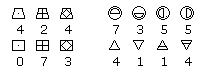
- In percentage terms (left checkbox) - presents the statistics
as percentages of the total planets in each category.
The popup menu of statistics panel have following items:
- Consider Asc and MC - check to inculude for calculation also Asc and MC.
- Interpret - show the reading of statistic. Should be activated the "Elements, Qualities, Hemispheres" text of the "Universal Interpretation" chapter of the operational bookshelf of the Library.
- Graphical Affetic - displays affetic value as colored lines (if checked)
or as digital representation (if unchecked) left of each listed planet.
The "Affetic" option should be checked in the "Additional data" table.
Left or right mouse click to affetics data invokes the windows with additional data. Right - for current planet, left - for all planets.
- Reference date of Returns in Header - displays for return charts the time
and date of computed planet returns in the planets list header.
When unchecked, the header displays the background event data, and the
Reference Date window must be opened to view the planet return details.
The options, colored by purple, used independently of checkboxes, mentioned above.
Select the data to be displayed from the listboxes (hightlighting are captions of headers, if "Header of Table" option checked):
- A Affetic - displays Lilly's Affetic index for each of the main planets. Place the mouse pointer on the affetic value and click to view a description of the affetic. The rules and factors for Lilly's affetic are defined in the file [ZET]\LANGUAGE\English\Affetic.txt,
- Q Quadruplicity, Element
- R Rulership
- D Degrees Characters - includes in the planets list the symbols for the
Royal (Rex) degree (!) and the Destructive degree
(?) if a planet falls in one of these degrees.
The Rex degrees (according the Babilonian ritual calendar) are: 18 Aries, 9 Gemini, 7 Leo, 25 Virgo, 13 Scorpio, 11 Capricorn, and 30 Aquarius. The Destruct degrees are: 23 Aries, 13 Gemini, 10 Leo, 1 Libra, 19 Scorpio, 19 Capricorn, and 4 Pisces. - R Ruler - allows to disply in the planets table a ruler(s) in sign, where the planet located
- E Exaltation - allows to disply in the planets table an exaltant in signs, where the planet located
- T Triplicity Ruler (see below)
- t Term Ruler (see below)
- f Decan Ruler (see below)
- d Degree Ruler (see below)
- D Detriment - allows to disply in the planets table a planet in detriment in signs, where the planet located
- F Fall - allows to disply in the planets table a planet in fall, in signs, where the planet located
- N Novenarium (see below)
- U Duodenariam (see below)
- H Sect, Hayz (see below)
- A Almuten of House (see below)
- M.M Moon Mansion - glyph of the Mansion of the Moon in which the object is located
- L Star Lord - planet-ruler of Nakshatra (Moon Mansion) by Jyotish.
Used only for systems of 27 Nakshatras (see Systems, Moon Mansions)
- L' Sub-lord - the planet-rulers of Nakshatras subdivisions
- L'' Prati-sub, L''' Sookshma-sub - the planet-rulers of
nested levels subdivisions.
Used only for systems of 27 Nakshatras and for similar type of current zodiac
and mode of Moon Mansion.
- B Baresma (by P.P.Globa - Russian astrologer)
- Lng Longitude - the coordinate is always ecliptical in the tropical zodiac
- Lat Latitude
- RA Right Ascension
- Dcl Declination
- HA Hour Angle
- Azi Azimuth
- Alt Altitude
- MP Mundane Position Placidian - the value of planet's position in a Mundane Zodiac
- HD Degree in House - houses are considered to comprise 30 unequal intervals (house degrees), which are derived from the size of houses in adjacent quadrants
- TD Degree of transiting planet - the House Degree in which a transiting planet (of the outer chart ring) falls
- V% Speed (% of average) - speed of the object as a percentage of its average speed (for planets), or speed in degrees per day for asteroids and other objects
- V Speed (deg./day) - speed of the object in degrees per day
- Vd Speed by Declination
- RE From Earth - distance from the Earth in Astronomical Units, or for the Moon in kilometers
- RS From Sun - distance from the Earth in Astronomical Units
- HLng Helio Longitude
- HLat Helio Latitude
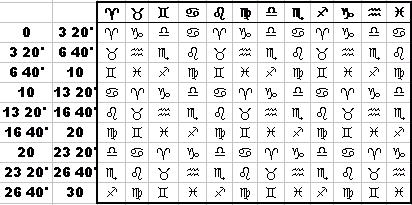
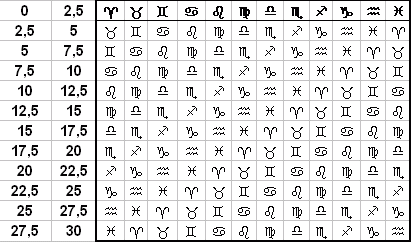
When these flags checked, then displayed the Zodiak sign, in which the planet is located in
9th (Novenarium) and 12th harmonic (Duodenariam of Medieval and Hindu mode).
The Arabic mode of Duodenariam (right check-box) displayed in the table below.
Novenarium Table:
Duodenariam Table (Arabic style):
THE CONSIDERATIONS OF GUIDO BONATUS, from William Lilly's translation of Anima Astrologiae:
87. The 87th is to Consider, Novenarium Lunae, which is a thing much to be heeded, for it often hinders the Astrologer from discovering the truth, and leads him into error, not knowing the cause that makes him deceive.
89. The 89th is to Consider, The Duodenariam Lunae, a thing that is observable in many cases, even more than divers things that we have said; for there is greatest danger of mistakes in abstruse considerations, and such as Astrologers rather sloth than ignorance, do not regard; whereby they often fall into disgrace and contempt of the rabble, rather than take a little pains.
The Sect is an ancient astrological concept in which the seven traditional "planets"
(including the Sun, the Moon and the five starry planets) are assigned to two
different categories: diurnal or nocturnal sect.
Diurnal planets are more comfortable and powerful when they appear in charts in
which the Sun is above the horizon. They include:
Sun
Jupiter
Saturn
Nocturnal planets are more comfortable and powerful when they appear in charts in
which the Sun is below the horizon, or at night. They are:
Moon
Venus
Mars
Mercury, a hermaphroditic and very adaptable planet, possesses no inherent sect.
Mercury changes its sect orientation depending upon whether it is oriental of
the Sun (that is, positioned so that it rises before the Sun rises and sets
before the Sun sets), in which case it is diurnal in sect; or occidental
(that is, rising after the Sun rises and setting after the Sun sets),
in which case it is of nocturnal sect.
As can be seen by the example of Mercury, which is more obscured by being occidental,
sect is a form of astrological polarity, much as the distinction between
masculine and feminine planets. Since some planets were seen to be stronger
in a positive or masculine environment, and others were seen to be more effective
in a negative or feminine environment, whether a planet is in sect in any given
chart was of particular importance to Hellenistic astrologers, who gave sect
greater weight than any other astrological factor.
Medieval astrology became even more complex in its treatment of sect--although
the factor itself became considerably less important. The Arab astrologers of the
Middle Ages, defined three forms of sect:
- a planet is in sect when it is in a chart where the Sun's position corresponds to its sect (such as Jupiter in a day chart, or when the Sun is above the horizon; or Mars in a night chart, when the Sun is below the horizon);
- a planet can still be in some sect if its sign polarity corresponds with its inherent sect (the idea being that Aries, Gemini, Leo, Libra, Sagittarius, and Aquarius were masculine or diurnal signs, whereas Taurus, Cancer, Virgo, Scorpio, Capricorn and Pisces were feminine or nocturnal signs.) Therefore Venus in Virgo is in sect by sign because Virgo is a negative, or feminine, or nocturnal sign;
- a planet might yet have some shred of sect dignity if it is in the hemisphere of the chart corresponding to its inherent sect--for example, if Jupiter is in the same hemisphere as the Sun, whether or not the Sun is above the horizon, or if Venus is in the hemisphere opposite the Sun, whether or not the Sun is below the horizon.
This option displays in the planets list
the glyph of the planet-almuten of houses (for houses that have been selected
on the Chart Settings - Houses tab for the planets list).
It's possible two variants of house almuten description: 1) as a ruler of sign
on a house cusp, 2) by Alcabitius.
Desired variant selected on a Almutens tab.
Additional
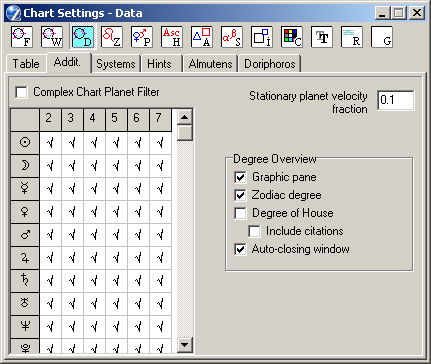
- Complex Chart Planet Filter -
this facility, activated by setting the checkbox, allows you to specify
separate subsets of the planets for each ring of complex charts.
The filter is particularly relevant to astro*carto*graphy, and allows for example
the Cyclo*carto*graphy technique of David Meadows to be realized,
i.e. combining natal ACG lines with a display of
lines for the progressed planets Sun thru Mars, and the transiting planets
Jupiter...Pluto.
Each column of the filter table (2...7) corresponds to a ring of the complex chart. Click the mouse in a cell to switch the filter flag. Activated planets are indicated by the checkmark symbol.
- Stationary planet velocity fraction -
the "Stationary planet velocity fraction" entryfield allows setting a threshold
velocity below which a planet will be treated as stationary.
Stationary planets are displayed in the planets list
with a superscript s adjacent the glyph. The
threshold is defined as a decimal fraction of the planet's average speed.
By default it is 0.1 (10%), but you can input any other value.
- Degree Overview -
the Degree Overview window is opened by selecting the menu item from the
popup menus of planet glyphs and cusp numbers on the chart wheel.
It can also be opened by pausing the mouse pointer over the outer rim of the chart wheel,
and clicking the mouse when the pointer icon changes to a page icon.
- Graphic pane - adds a sub-pane in the window with a graphic representation of the zodiac degree and the objects located in the degree. (NOTE: when unchecked, and the "Degree of House" option is checked, the resulting window comprises the titlebar only),
- Zodiac degree - displays interpretation text for the degree, drawn from the Sabian Symbols theme of the Operational bookshelf of the Library. If the theme is not selected on the Operational bookshelf, no text is displayed.
- Degree of House - not used in the English version due to non-availability of appropriate interpretation texts.
- Include citations - inserts a text caption after the interpretation text citation.
- Auto-closing window - when checked ON, the Degree Overview window closes when the mouse button press which invoked it is released.
The Degree Overview window can display activated Arabic Parts, all items from the Catalog of Asteroids (if the "Current Date" regime setting is selected), and stars (according to the specified star filter).
Systems
-
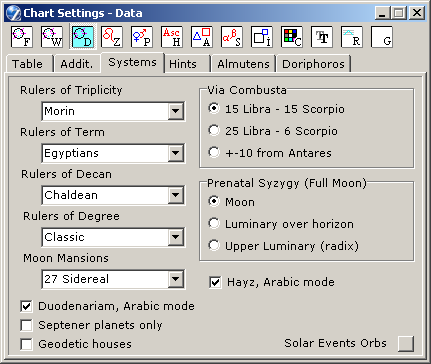
Ruler of Triplicity - includes in the planets list the glyph of the
planet-ruler of the element triplicity in which the planet falls.
The "Method of calculating triplicity ruler" listbox allows you to
select between three versions of the Ruler of Triplicity:
Dorotean, Morin, Ptolemy. The definitions of these are in the
corresponding .trr files:
Dorotean.trr
// Day Night Participating
Fire Sun Jupiter Saturn
Earth Venus Moon Mars
Air Saturn Mercury Jupiter
Water Venus Mars Moon
Morin.trr
// Day Night Participating
Fire Sun Mars Jupiter
Earth Mercury Saturn Venus
Air Saturn Venus Mercury
Water Jupiter Moon Mars
Ptolemy.trr
// Day Night
Fire Sun Jupiter
Earth Venus Moon
Air Saturn Mercury
Water Mars Mars
- Ruler of Term includes in the planets list the glyph of the planet-ruler
of the term in which the planet is located.
The signs of the zodiac are considered divided into 5-7 intervals - terms of some value.
These divisions may depends of day or night chart.
The "Method of calculating term ruler" list box allows you to
select between several versions of the Ruler of Term:
Bonatti's, Egyptian's, Ptolemy's, Lilly's and others. The definitions are in the corresponding
.ter files.
E.g. if the Sun's longitude is 12°10'04" Pisces, the ruler of the term in which the Sun is located
is Jupiter (in all versions).
-
Ruler of Decan includes in the planets list the glyph of the planet-ruler
of the decan or face (Lilly) in which the planet falls.
Zodiac signs are considered divided into 3 equal intervals (decan or face) of 10 degrees.
- The first decan of Aries is ruled by Mars, the second by the Sun, and so on
according to the Magus Star sequence (Mars, Sun, Venus, Mercury, Moon, Saturn, Jupiter).
The description of this system is (5,1,4,3,2,7,6) and contained in "Chaldean.dec" file.
E.g. longitude of Uranus is 26°47'50" Leo. This is the 15th decan of the Zodiac.
To calculate the number of the planet-ruler from the Magus Star sequence, use the formula:
i = (n-1) mod 7 + 1,
where n = number of decan, mod - remainder after dividing.
So i = 1, and in this example Uranus is located in the decan (face) of Mars.
- Some modern astrologers expands this seguence with highest planets: Uranus,
Neptun, Pluto. So the circle sequence is (5,1,4,3,2,7,6,10,1,9,8,2,7,6).
It contained in "Modern.dec" file.
- The so called "Avestian astrology" sometimes used the Proserpita and Chiron
except Saturn and Jupiter, so the rulers seguence is (5,1,4,3,2,7,6,10,1,9,8,2,15,16)
and located in " Avesta.dec" file.
In the system, described by Manilius, first decan of every three signs of each Element ruled by 1st sign of this Element (according sign sequence from Aries), second decan - 2nd sign, third - 3rd sign. So the Aries (Mars) is ruler of first decans of Aries, Leo and Sagittarius. the Leo (Sun) is rules of it's second decans, and the Sagittarius (Jupiter) is rules of it's third decans. The description of this system located in "Manilius.dec":
// Ari

  5,1,6,

// Tau

  4,3,7,

// Gem

  3,4,7,

// Can

  2,5,6,

// Leo

  5,1,6,

// Vir

  4,3,7,

// Lib

  3,4,7,

// Sco

  2,5,6,

// Sgr

  5,1,6,

// Cap

  4,3,7,

// Aqr

  3,4,7,

// Psc

  2,5,6
- The Indian system of decan rulers:
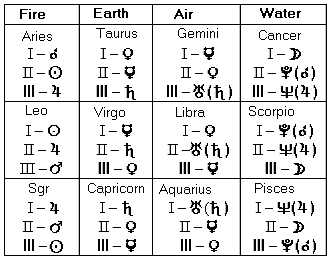
The description of this system located in "Hindu.dec" file:
// Ari

  5,1,6,

// Tau

  4,3,7,

// Gem

  3,4,7,

// Cnc

  2,5,6,

// Leo

  1,6,5,

// Vir

  3,7,4,

// Lib

  4,7,3,

// Sco

  5,6,2,

// Sgr

  6,5,1,

// Cap

  7,4,3,

// Aqr

  7,3,4,

// Psc

  6,2,5
This system also may be modified with highest planets, see "HinduM.dec" file.
There are several systems of Decan Rulers:
-
Ruler of Degree includes in the planets list the glyph of planet-ruler
of the degree in which the planet is located. There are several systems of Degree Rulers:
-
First degree of Aries is ruled by Mars, the second by the Sun, and so on upto 30th degree of Pisces according to the Magus Star sequence. E.g. the longitude of Mars is 19°22'26" Taurus. This is the 50th degree of the Zodiac. To calculate the number of the planet-ruler from the Magus Star sequence, use the formula: i = (n-1) mod 7 + 1, where n = number of decan, mod - remainder after dividing. So i = 1, and in this example Mars located in its own degree.
The description of this system is (5,1,4,3,2,7,6) and located in "Classic.dgr" file. Some astrologers in the even cycles of this sequence replays planets by highest: Venus by Neptune, Merqury by Uranus and so on. See "Modern.dgr" file: (5,1,4,3,2,7,6,10,1,9,8,2,7,6) and "Avesta.dgr" file: (5,1,4,3,2,7,6,10,1,9,8,2,15,16). Note: 15 - Proserpina, 16 - Chiron.
-
Other system described as follows:
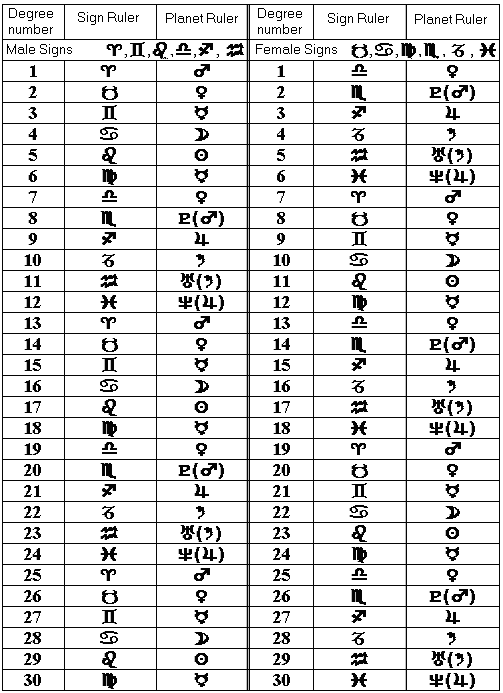
See Degrees.dgr: (5,4,3,2,1,3,4,5,6,7,7,6) and DegreesM.dgr: (5,4,3,2,1,3,4,10,6,7,8,9).
-
The Hellenistic astrology system takes into account day or night chart with different rulers. This described as follows:
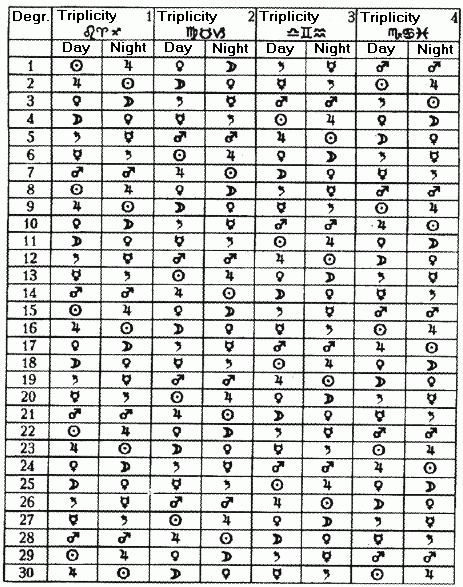
See Paul.dgr:
*Day
(1,6,4,2,7,3,5)
*Night
(6,1,2,4,3,7,5)
- on the left top corner of chart, when the "Moon Mansions" checkbox (Chert Settings, Format tab) checked
- on the additional ring of chart, when the "Moon Mansions" checkbox (Chart Settings, Wheel tab, Belt page) checked
The Mansions of the Moon (Lunar Mansions) are a subdivision of the Moon's journey through one complete circuit of 360 degrees, each Mansion representing one day's average travel of the Moon (12° 51' 25.2", or roughly 13 degrees), beginning apparently at the point of the Spring Equinox, or 0° Aries. In Hindu astrology the Mansions are called Asterisms, and are indexed from the beginning of the Hindu Zodiac.
The drop-down listbox allows selection of a system of mansions. Predefined systems include:
28 Tropical - 28 equal mansions segmenting the ecliptic from the vernal equinox
of the tropical zodiac,
28 Sidereal - 28 equal mansions segmenting the ecliptic from 0° Aries in the sidereal zodiac,
27 Sidereal - 27 equal mansions segmenting the ecliptic from 0° Aries in the sidereal zodiac.
It is also possible to define other Moon Mansions Systems.
The Mansions of the Moon displyed
-
See above
-
Restricts the usage of planets in calculations and for chart display to the
traditionally-known Septener set of planets, e.g. for horary.
-
Selects the Geodetic system of houses, e.g. for mundane charts.
Houses are calculated by latitude and longitude only, and time is not used.
Via Combusta
- Select a variant of Via Combusta description:
- 15 Libra - 15 Scorpio.
- 25 Libra - 6 Scorpio.
- +-10 of Antares (fixed star).
Prenatal Syzygy (Full Moon)
- The "Prenatal syzygy" point calculated by following rule:
If prenatal syzygy is New Moon, then get it's degree.
Else (Full Moon), use one of three variants:
- Moon (on a moment of prenatan Full Moon),
- Degree of luminary over horizon on a moment of Foll Moon,
- Degree of luminary, which is highest (upper) in radix.
Hayz, arabic mode
- Additional option to described above (Table, Additional data, "Sect, Hayz").
Solar Events Orbs
- Allows to set of "Combast" and "Under Solar Beams" for septener planets.
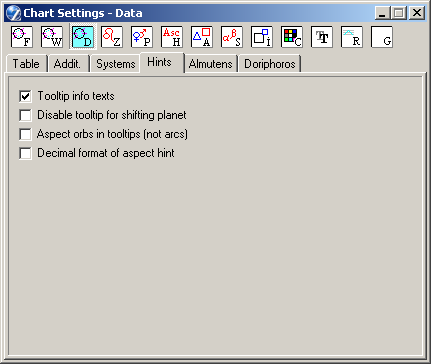
Hints
Almutens
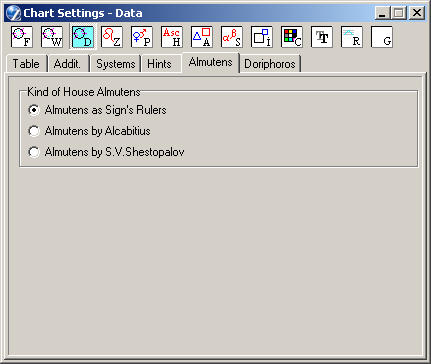
- Choose one kind of house almutens calculation:
- Almuten is a ruler of Sign on a cusp of this House.
- Almutens by Alcabitius: There are five Essential Dignities for any degree of the zodiac: rulership (+5), exaltation (+4), triplicity (+3), term (+2), and face (+1). Take a particular house cusp, find the planet which rules each of the five essential dignities of the position, and assign points to the planet. The planet with the highest points value is the Almuten. For example: for 8°15' Aries, Mars is the ruler (+5); the Sun is exaltated (+4) and rules the triplicity (+3) and face (+1) = +8; and Venus rules the term (+2). Therefore the Sun is the Almuten of the degree.
- Almutens by S.V.Shestopalov: see The links of house elements
Doriphoros, Auriga
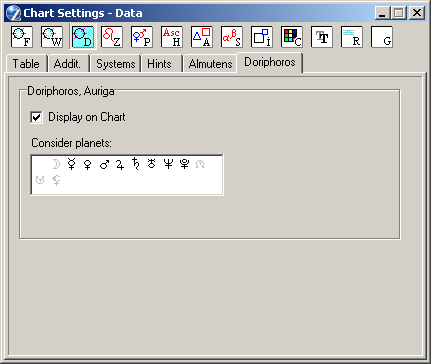
There is an option of displaying "Doriphoros" and "Auriga" planets on a chart, and possibility to setup any set of planets, recognised as Doriphoros and Auriga (also used in astro-formulae calculation).
Doriphoros (doryphory) the planet rises directly before Sun. Auriga: the planet sets directly before Sun.
To select a planet to consider as doriphoros or auriga click it's glyph by mouse. Selected ones are black, unselected are gray.